Saturday, 30 March 2013

In the lap of Nanda Devi (Part I)

 (A trip to Auli,Joshimath,Tapovan,Gorso Bugyal.Kuari Bugyal,Rishikesh,Haridwar with friends)

Day 1: The Unplanned Journey-
  We made our plan of the trip just few days before with one of the friends coming in just one day back. All four of us gave awesome and creative explanations to our families  for not coming to home on Holi vacations with one of us even not informing them about the trip. We couldn’t get a tatkal reservation so decided to travel by bus, which indeed was a bad decision. We left the campus in the evening around 7Pm, reached the bus stop and took a bus to Bareiley. We were expecting to reach Haridwar by 8Am but of course one should not predict about Indian roadways and Railways. Meeting many traffic jams, accident sites and changing bus two times we reached Haridwar at 12.30Pm next day.

Day 2: The Holy Dip (Rishikesh)-
Reaching Haridwar we had lunch and then took a bus to Rishikesh which is about 25kms from Haridwar. Buses are easily available and we reached Rishikesh in one and half hours. We decided to spent rest of the day in Rishikesh as buses to Joshimath are available only in the morning. After resting for sometime in a relatively cheaper room because of offseason benefits we left for Lakshman Jhula. On the road to main Ghat one could find many shops providing services for Adventure sports like rafting, trekking,wild safari, camping, bungy jumping  and many more.I doubt that once a religious place, Rishikesh has now become a place for adventure sports with adventure shops rising in numbers at least 4 to 5 times then the number of temples there. One more peculiar thing was that you can find more people in rafting boats and on the banks of Ganga in Shivpuri then on the Ghats of Rishikesh near temples. Finally we reached Lakshman Jhula, its a hanging bridge on Ganga, vibrating up and down when people move on it. We spent some time jumping on it, clicking photographs and discussing how resonance can bring it down in the Ganges flowing about 30 metres below. 
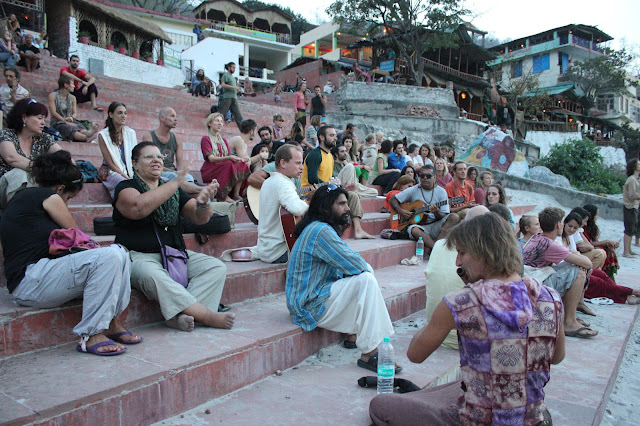
We reached the Ghat below after sometime with intentions of taking a bath but touching the ice cold water we almost left the thought. After much of provocations two of us jumped in the waters. It was too cold but relieving. Following us two other foreigners also jumped in. One very strange thing about the Ghats in Rishikesh was that we could only see 2 or 3 Indians there, rest of them were all foreigners.  Sometimes it felt as if we were in a British colony. Some were busy in reciting mantras and hare ram hare krishna. There was a group of 50 foreigners near by singing the tone of Shiv Shiv Shiv Shambhu with the help of Guitars and flutes. It was so sweet to ears that we sat with them. There was a girl painting the Ganges ghat in the sunset .In Rishikesh you can find many foreigners getting inclined to Vedic religion, practising Hindu rituals, reciting mantras and bhajans, some even becoming saints. We returned back with a walk of 7kms passing the Ram Jhula and temples.
Day 3: The dangerous turns-

The next day we woke up at 4 as we had to leave for Joshimath. Private buses are available from Rishikesh till 7 Am and a bus is there from Haridwar at 5.30Am. We took a bus from Rishikesh at 6Am, it was a small bus with not so comfortable seats but we had no other option. The road from Rishikesh to Joshimath is all along the banks of Ganges, providing a wonderful picturesque of mountains and the rivers. Because of the awesome scenery the 250kms distance consuming a time of 10-11 hours doesn’t seem boring at all. On the way there are many towns, some of religious importance like Dev Prayag, Nand Prayag,Rudra Prayag,Karna Prayag and cities like Srinagar and Chamoli. Prayag means confluence of tributaries of Ganga. The road however was a bit damaged and very often one could find boards saying-"आगे रास्ता संकरा है और धंस रहा है | कृपया सावधानीपूर्वक चले ". Many a times I found the tyre of the bus just passed the damaged corner of the road. A small mistake from the driver could have very easily lead to the salvation of the 50 lives onboard in the Holy Alaknanada itself. When we were just 50kms from Joshimath,a suspension of spring of one of the front tyres got broken.Now the driver was driving it at a rate of 15kms/hour and finally we reached Joshimath around 5Pm.
 
On reaching the taxi stand we met some of our seniors who reached there in the morning for vacations. We then talked to some of the people providing services of trekking and camping for a possible trekking activity. All of themrefused considering the heavy snow in the Kuari  pass region saying that it was risky and also Police won't grant permission. However one of them gave the contact details of a guide from Auli and said he may do something for you. Now the most interesting thing- After 2 days, including us 3 groups were doing trekking in Kuari Bugyal region inspite of the fearful warnings from the locals, and the best part-All the three groups were from IIT Kanpur.

Day 4: Lost in the Wild-
As per plans we had to spend next day in Auli which is about 16kms from Joshimath. Instead of taking a taxi we decided to trek through the village and the forest ,with shortcuts distance reduced to about 7 kms. We left for Auli around 7am.While passing the village we had to trek through the stair cases which became a difficult task with heavy load on my back. When the village ended we had two options either take the road to Auli or go in the forest through some more short cut routes. Locals suggested not to go in Jungle because we might get lost, but we did. It was great fun with splendid greenery and birds chirping all around. The fun turned to excitement soon when we saw the snow and then to adventure and then to terror when we realized that we have lost the track and we were just wandering here and there.
 Out of fear we put our cameras in bags and started applying all our brains to get the right directions. We had just 1 packet of biscuit and 200 ml of water left. We decided to reach the top of the snow clad hill as from there we would be able to easily see Auli and then proceed. But the hills are decisive, as we moved up we could see some other hill tops to reach. In the snow it was difficult to climb up so we left the hope and started descending right. Coming down in snow was again risky and we slipped many times. After 3 hours of wandering in forest with no food and water we finally found a one ended road which lead to the main road.
After reaching Auli we took a room, had some food and left for skiing. There is a chair lift available from GMVN hotel to the ski resort. It’s a bit costly but the experience is worth the money invested. The ski resort has an international ski slope of 1.5 kms with all the modern facilities.SAIF winter games were held this year in Auli.We were given some heavy shoes and practised walking with them without support. It took us some time to learn the balancing on snow but it was great fun later. We fell many times in the process. We forgot to bring our gloves and our hands got frozen. I also had a sweet little snow fight with a kid there. From there one can get an awesome view of Nanda devi and other peaks covered in snow. After 3 hours of skiing we were tired and decided to come back. In the evening we contacted the guide, gave him some advance money and fixed our trekking tour.


Part II

Photographs by- Sravan Photography

Monday, 17 December 2012

Gift..... (a short story)


 In English script--
School ki ghanti bajte hi Rahul ghar ki taraf bhaga. Vo aaj subah pahli class ke baad se hi bahut jyada khush tha, aur ho bhi kyo na , pahli bar maths me uske 50 me 50 marks aaye the.  Uski isi khushi ki vajah se aaj class ki sari ladkiyo ko pata chal gaya ki uska aage ka daat tut gaya hai. Halanki ek nanha sa daat us jagah ko bharne ke liye nikal pada tha, par khidki to khidki hoti hai, ab vo aadhi khuli ho ya poori.  Aaj use ghar jane ki itni jaldi thi ki vo school ke gate pr milne wali apni pasandida imli ki khatti mithi goliyaa lena bhi bhool gaya. Use ghar pahuch kar maa aur daadi ko apne naye record ki khabar sunani thi bas.  Rahul ka ghar school ke pas hi tha aur vo 5 minute me ghar pahuch gaya. Uske baal uljhe hue, daudne ki vajah se chehre par pasina tha, thak jane ki vajah se use saans lene me thodi mushkil jarur ho rahi thi par uski muskan me koi kami nhi ayi thi. Uska coat uske haath me tha , tie shirt ki pocket se bahar latak rahi thi, usne roj ki tarah ek haath gate ke andar ghusaya  aur ek chalaak chor ki tarah asani se  gate khol liya. Rahul apne muumy papa aur daadi ke sath ek kiraye ke ghar me rahta tha. Vh ghar chaalis saal purana tha. Us ghar me unke sath hi ek aur kirayedar rahte the. Dono ke pas do do kamre the jinke bich me ek  patli si gallery thi. Un charo kamro ke samne ek chota sa aangan tha, jisme dopahar ke samay thodi dhoop aa jaya karti thi. Rahul jese hi andar ghusa, usne  aangan ke kone me kursiyo pr baithi apni maa Sudha aur dadi ko dekha. Vo  dono sardiyo me khali vaqt me vaha baith kr dhoop sekti thi.  In dono saas bahuvo ka pyaar puri colony ke liye misaal tha.  Sudha ka vyavhar sab k sath hi accha tha, ghar me aane jane wale mehmano se lekr , naukar chakar tak sab hi Sudha ke polite nature se impressed the.  Chahe dudh wale bhaiya ho, ya sabji wale, ya fir jamadar sabhi ko Sudha ne apna bhai bana rakha tha. Aisi padhi likhi sabhya shushil, khule vicharo wali mahila is jamane me durlabh hi thi.
Khair apni maa aur dadi ko dekh kr Rahul jor se chillaya-“Mummy I got 50 out of 50 in Maths”, aur teji se unki god me ja chhupne ke liye dauda. Jaldbaji me usne bich me rakhi hui thaali pr dhyan nhi diya aur jor se thokar mar di. Thaali me rakhi hui pital ki katori uchal kar samne ki deewar se ja ladi aur khan khan ki awaj karte hue, aangan ke duri or bani naali me pahuch gayi.  Us naali me dono bathrooms ka pani jata tha. Katori ko nali me jata dekh, Rahul bich me hi ruk gaya. Shyad use aage hone wali chijo ka andaja ho gaya tha. Sudha ne Rahul ko naali se katori uthane ka ishara kiya. Agar aur koi din hota to shayad is laparvahi ke liye pitai bhi ho jati, par aaj Rahul itne acche marks laya tha isiliye shayd Sudha ne kuch kaha nahi. Rahul chup chap apne kamre me gaya aur apna bag aur coat rakh kea a gaya. Usne katori uthayi aur sabun se dhoya. Fir Sudha ne us katori ko deewar ke upar alag rakh diya. Rahul ko sardiyo me fir se nahan pad gaya. 
Do din bit gaye, vo katori vahi diwar par rakhi rahi. Fir us din colony me safai karne wala jamadar Kamal paise lene ke liye aaya. Kamal bhi Sudha ko didi hi kehta tha. Sudha ne kamal ko mahine ke 100 rupaye aur kuch bachi hui mithai de di. Kamal paise lekar muda hi tha ki Sudha ko kuch yad aa gaya. Usne kamal ko roka aur kaha- “Are kamal maine tumhe tumhara gift to diya hi nhi. Sudha ne deewar pe rakhi katori uthai aur Kamal ko de di. Peetal ki badi si katori ko haatho me dekh kr Kamal ki aankho me chamak aa gayi, pr agle hi pal vah kuch soch ke chauk sa gaya.  Usne badi vinamrata se Sudha se kaha – “Didi ye katori naali me gir gayi thin na, tabhi aap mujhe de rahi ho…Khair ab mai isme kheer to khaunga hi aapne itne pyar se jo ye gift diya hai…”. Itna kah kr Kamal namaste kr chal diya. Sudha Kamal ke shabdo ki chot se stabdh si rah gayi.

Wednesday, 28 November 2012

Should the tribals be left alone…???


A question which keeps on pondering  various Governments, social workers, policy makers, academicians  and yes sometimes the common people too.  The question may seem to be simple, but the answers to it are not. Infact no Government policy throughout the world has been able to satisfactorily deal with this issue. 
I was confronted with this question for the first time in my first year, while taking a course on Indian Society & Culture. Since then it regularly keeps on popping up somewhere or the other. Recently in the last month during Antaragni, one of the participant colleges presented a street play on the case of Jarawa tribe of Andman & Nicobar, posing the same question again. This however is a good indication that more and more people specially youth are connecting themselves to discussions on such critical issues.

Tribals are the small or large (sometimes) groups of people living in isolation from the main world in forests, having a distinct culture, language, life style and religion. They generally depend on the natural resources present around them, feed themselves from the forest produce and largely practice shifting cultivation type of agriculture. In India there are 689 Scheduled Tribes, having a population of 67.8 million people, consisting of 8.08 percent of India’s total population. Since the invasion of foreigners tribal people have not been in a good state. British with their Criminal Tribes Act  1871 threatened many tribal people by imposing restrictions on their activities. After independence, the Nehru government thought for the betterment of the tribes. It laid down the foundation for the policies to bring Scheduled Tribes into the mainstream of society through a multi-pronged approach for their all-round development without disturbing their distinct culture. Nehru laid down five principles known as Panchsheel for the betterment of tribals. According to him tribals should be given rights in land and forest, their administration should have minimum outside interference, their social and cultural institutions should not be disturbed and they should be left to develop themselves on their own genius. 

The Nehru’s decision to bring the tribals in the main stream (although slowly) has been a matter of considerable debate and has been criticized by many sociologists. Nehru’s prescriptions may have sought some positive results but they have been comprehensively ignored by the Central as well as the State Governments. All the rights given to them have been significantly denied specially the right of possession of land and forest. They are forced to migrate to other places for construction of dams, roads, natural parks, digging of mines and construction of large scale industries. They are provided with settlements to live in which are badly constructed and poorly organized. Now think of people who have lived with nature, wandering from here to there, collecting food are forced to live in boundaries. Although buying of lands from tribals is not allowed, but the corrupt Governments help Corporates to acquire large areas for setting up industries, disturbing the tribal way of life greatly. They have been entitled for Sarva Shiksha Abhiyan but the position of schools in such areas is very bad. The primary health and medical services are also suffering. And talking about administration, there has been no such significant effort by the Government to bring them in the system. In short we can say that the Governments and the Corporates are both exploiting the tribals a lot. There are also regular cases of exploitation of tribals in tourist areas by Indian as well as foreign tourists. The police and the army are also no less involved in it. As some recent studies have shown that the tribals of India have gained least and lost most from six decades of Indian independence. Because of such an attitude from Government, many tribal communities have been misled by various missionaries and activist groups like Naxals.

We are forcing them to a lifestyle which is completely different from theirs. We show them the modern ways of living and leave them to survive by themselves. We do not provide them sufficient help and support to adjust and grow. Most of the times, these people on assimilation go into some cultural shock. There have been cases where these people because of unemployment and failures, lose their self respect and end up in activities like begging. On contact with the external world they also develop diseases to which they are not immune.

On the other hand there is one more perspective. These tribes often face famines and epidemics. This was one of the reasons to bring them in the main stream. Also most of the natural reserves of national importance like coal, iron and other minerals are present in the areas which are occupied by the tribal population. So for the growth and development of nation it is important to harness them. Also construction of roads and dams because of similar reasons is necessary. But for it, tribal people will suffer no matter how many incentives we create, because natural home is home and it takes quite a long time to adjust and assimilate. The best way is to aim for development without changing the culture, tradition and life style of tribals but its not that easy.

So the question is still there- Should the 8% population be disturbed for the benefit of rest 92% OR Should they be left alone..??


Sunday, 23 September 2012

The Balloons Of National Family Planning Programme


India is a land of quality paper work. We have the largest written Constitution, we construct fantastic buildings, roads and bridges with crores of rupees on paper, sometimes we even produce imaginary population on paper. Papers here can eat grains, kerosene, concrete, cement and what not. We have many development policies and programmes, which look great on paper. The principles and fundamentals which our policy makers use to frame these policies are the ideal, but most of these policies fail or under achieve because of the implementation techniques. If some theory exam is organised on ideal policy making, India will surely top in that. The programmes on Health and Family Welfare, Sarva Shiksha Abhiyan, MNREGA, MDM ,Reservation policy and many others have seen inappropriate or sluggish implementaion. Anyways this post is for the National Family Planning Programme.

I am doing a course on Demography this semester. One day while discussing the fertility aspects and birth control our Professor told us about the family planning programme in India and its success and failures. It was a proud feeling to know that India was one of the first countries to implement a nationalised family planning programme. There were advertisements on radio promoting use of condoms, sterilisation and other birth control techniques, big posters of “chhota parivar- sukhi parivar” were put on roads and public places. Policy makers thought that these written banners will motivate the massively uneducated population of India. People were given gifts, monetary benefits and incentives if they agreed to get sterilised. The condoms and other things were distributed for free. And on the results part of this policy there were lakhs of sterilisations- most of those were of people of age above 40(when they already had 3 to 4 children) and many on paper only. Women were forced to get sterilised, even when the operation involved was comparatively very easy for men. Even the people living in villages had the availability of condoms, but no one knew how to use them. On a conclusion note our Prof made a statement- “ In the 70’s and 80’s if you go to some village you can easily find children playing with the condom balloons”. Whole class burst in laughter on this but it was like “WHAT….???” for me, because I remembered something.

This discussion made me reel back my life to 1998-99. During the school vacations we used to go to our village. In the village I used to forget all the adequates and language which the Christian Convent School taught me and become one of them. I played and mixed with all kinds of children there, some wearing dirty clothes, some wearing only pants or underwears, some having nose running out. Everyday I got an ultimatum from my mother- “agar agli bar in gande baccho ke sath khelte dikhe to taange tod dungi”. But I went daily because they had really interesting games. One of the games which was very popular those days was playing with balloons. These balloons were really cheap- you can get around 10 in 1 rupee, some children even got them for free, I used to wonder from where they get it. Inspite of being so cheap their size was very big as compared to the normal balloons. They had a peculiar characteristic- they exploded if they fell on grass or even touched it. I remember I spent a lot of time in trying to discover why only these balloons explode on falling on the grass, while the normal ones don’t. Anyways this led to a discovery of another interesting game for us- balloon volleyball. We played voleyball kind of game with them, the one who missed his shot, his balloon fell on the grass and exploded. We even celebrated one of our friends birthday with those balloons. I used to do all this non-sense far away from the reach of my home so that my family members specially my father doesn’t see me playing with those kids. One day by mistake I reached home with one such balloon in my hand and unfortunately met my father on the gate itself. He scolded me heavily and forbade me not to step out from the house for 2 days as a punishment. At that time I couldn’t figure out why he scolded me so much for just playing with a balloon. I asked this from my mummy and even she showered all her anger on me. I came to know the reason of that punishment after these many years in class that day. But I still don’t know why those balloons exploded on touching the grass. :P 

Anyways if someone asks me now –“Have you ever bought a condom?, I can proudly say- “Condoms, I used to play with them in my childhood man.” :P :P 

Friday, 7 September 2012

Few things I learnt from you


“Everything and everyone in this world is beautiful, just see it the way it deserves to be seen…
”-a one line philosophy of my life. I believe that everyone is special and is gifted with some unique qualities. By qualities here I refer to the ones which form a person’s character, nature and behaviour. If you have some observational skills you may find it all around you, amongst your friends. I have seen people following and copying great personalities of the history. However I feel if you observe people around you only, you’ll get many things to learn, and it is always more practical to follow a common man than some great one. So here in this post, I am summarizing some of the things which I learnt from “you”. You may think them to be extremely philosophical or weird, but giving a deep thought will somewhat convince you that these things are valid in today’s world. Some tips to be happy-

Have multiple “BEST FRIENDS”:
The statement “have multiple/many best friends” is grammatically incorrect. The very definition of best means that it can be just one in number. But the days of Jai-Veeru and Heer-Ranjha type friendships are now gone. The world today is so fast, busy and selfish, that when you need your best friend, many a times he isn’t available to you. You would have surely felt one such moment when your best friend has intentionally or unintentionally hurt you. These days’ people have many good friends and enjoy with one when the other is not available. I have even heard statements like-‘I have 3 best friends or 4 best friends’. Here there is one thing to keep in mind- all these friends are best but no one is special.

Talk Much, Share Less: 
In my childhood I was taught that people who talk a lot are good at heart and have pure thoughts, because talkative people share everything whatever they have in their mind. But in today’s world the more you share your life or secrets, the more the problems you’ll face. People will surely backstab you at some point of time in your life for the things which they know about you. This backstabbing can be in the form of a small comment which will shake you from top to toe. Also the more you share with someone, the more emotional attachment you develop. And believe me this “emotional attachment” is the worst disease. In today’s professional world you will have to talk a lot, but do this talking by mind, not by heart.

Enjoy the present, Forget the past:
What to say about this, it’s a well known fact. But I have one point to make here, what things to forget from the past? People say forget the bad memories because keeping them with you will always hurt. But I feel keeping the good memories also hurts. These good memories are very typical things, they may fill your face with laughter or even your eyes with tears. It depends on how and in what conditions you are remembering them. I feel that after a certain period of time even these good memories start hurting because something or the other happens to the person or persons who were a part of that memory( this happening may be as simple as breaking of a relationship).

Never Fall (for anyone):
In very simple words-falling always hurts. Be down to earth in your behaviour but never let anyone conquer you. Don’t develop extreme attachment or feelings for someone. The people are too ignorant to understand you, even if they understand you they are too rude to care and even if they care, they are too busy to carry it on. Once you fall you become like a coin which is kicked from here to there. If you are lucky enough someone may pick you up, but even he won’t kiss you.

These things are not exactly my mind’s creation. I have observed them in real life and just attempted to provide some explanations in the context of today’s world.
Although I have written these points, I haven’t been able to follow them yet nor I am planning to follow because- “khush rahne me bs khushi hai, par gam me zindagi hai..”

Criticisation welcomed... :)

Tuesday, 4 September 2012

a fairy tale...


When I was a kid, I used to love the fairies and their tales as all other kids do. Usually grandfather or grandmother are the ones who paint the child's mind with such colorful stories but my case was different. My grandparents used to tell us the spiritual stories,Ramayana,Mahabharat, a field in which they were expert.
I used to read the fairy stories from various books and magazines. I still remember joining letters then forming the words and then recollecting all the words with great difficulty to ultimately read one sentence.But I loved it this way only. Reading stories by yourself opens before you the great opportunities to imagine things, specially when your reading speed is slow. The fairies used to help the poor honest kids or the ones who lost their parents and also sometimes the princes to help them find their princesses.

Slowly and slowly as the time passed, science books kept on creeping in our school bags.They taught us to question things and find reasons. I think I rather quickly adapted this scientific temper. My family members keep on telling me stories how I used to irritate them with my questions on all damn things.With such an attitude I easily figured out that nothing like fairy world exists.I remember how my interest shifted from stories to scientific literature or books.

Years passed and these fairies remained out of my life. Then there came a time when I started realizing the real face of this world- the poverty, the starvation, homelessness.I started feeling that its more important to focus on these problems then on scientific ones and I was amazed to know that there are many people in this world doing that, living their life to help others. I saw in them the same angel or fairy which Nandan & Champak used to tell us in stories.People loved them like we loved our fairies. I remember when I was about 5 or 6 years old, one day I was going somewhere with my father. A group of people was coming from the opposite side weeping and crying loudly. My father stopped them and asked what happened? They told Mother Teresa has left the world.My father was also very shocked and I could clearly note the changes in his expressions. I dont know why I still remember this. That day I was'nt able to understand why these people were crying. But later when I grew up and studied about the great lady, everything was clear to me.

People like Mother Teresa are the fairies of this world. They dont have those wings or supernatural beauty but have all the love which they shower on the needy. I consider every single person as a fairy/angel who has a heart for others, who thinks for improving the situation of the poor and the needy.

Fairies exist, not with beautiful wings but with beautiful hearts having tonnes and tonnes of love in it!!

Sunday, 2 September 2012

The Magical Sticks!!


Yesterday morning at 5, I saw a group of students working hard with some wooden sticks, trying to arrange and fix them in a manner to challenge the destructive earthquake waves. Seeing them I remembered the Takneek of my first year ie. Takneek’10. In a manner similar to these guys and at the same time of the day ,me and my friends were busy in showing our best of working skills and applying all sorts of physical and mathematical logics to build an earthquake resistant building without having any knowledge of Engineering. We were one of the two teams, who were representing our pool Mauryans in Tremor.

The story started with a highly motivating GBM, instilling in us the wish to learn all the engineering skills in few weeks. We attended all the lectures of Electronics and Robotics as everyone does. We were about to participate in some robotics events but the coordinators conducted a quiz to test our knowledge and we were out. We were really in a sad situation because now we had nothing to participate in our first technical competition. In a depressed mental state and saying all sorts of foul words to the coordinators, we were lazily browsing through the Takneek website. Suddenly one of my friends pointed towards the 30 point event Tremor. The problem statement was to design an earthquake resistant building model using wooden sticks. Initially we were not all interested in a boring civil engineering event but the thought of winning 30 points right away for our Hall lead us into it. We discussed with our wingies and came to know that none from our batch was participating in the event. We were now seeing it as a real golden opportunity to do something cool. We studied the given problem statement and all the literature suggested thoroughly. The deadline to submit the abstract was only three days away. I still remember how we called the coordinators more than 10 times everyday, raising questions, discussing with them and clarifying our doubts. Even one of the coordinators gave us a short tutorial on earthquake engineering. Somehow with the new concepts learned and from the old concepts of centre of mass and stability we prepared our design. We also had to submit the simulation model of the design suggested but having less time we just drew the projections of it on some A3 sheets. When we submitted the abstract to the coordinators, they were stunned by the TA drawing skills of my roomie Sravan. But there only we came to know, that there were 3 more teams participating in it from our hall and they were all 2nd yearites. Our all dreams just shattered. But the next day turned out really special for us. Two abstracts were selected from our hall and ours was one amongst them. Even the coordinators appraised our work a lot.

We got the material two days before judging. As we had no prior experience in wood work, we contacted some of our seniors. They not only came with us, but remained with us till the end. With two nite-outs and a lot of hard work, we completed our design well before the judging of the event. When we reached with our model in the testing laboratory, one of the assistants there seeing its strength and stability said-“It will not break even if it is kept for 5 mins on the shcok table.” We were overwhelmed. Finally the competition started and we saw the models collapsing, breaking and falling on the ground. When our model was placed on the table, all of us were red with nervousness. But the assistant was correct, nothing happened to our building even when it was tested for 1 minute duration. We were now sure that we have a fair good chance of winning. Finally the results were declared, and guess what we were first. All the happiness showered on us from the skies. And to add to our joy, the other team from our hall was declared second. We were super excited now and even started “Hall 3 ka tempo high hai”, in the lab itself.

We returned to our hall, carrying those unharmed buildings as our trophies and shouting and cheering with our full effort. We came and placed the models in the quard. A large group of students surrounded us, praising our efforts and congratulating us. There was a sudden wave of joy in the Hall because of the 48 points which we won in a single shot. After this whole episode, I developed a huge interest in civil engineering. Earlier I used to think that it is just about putting one brick on top of the other, but now I realised that it is much more than that. It is a complex and wonderful science without which our lives will become helpless.

That one week of Takneek has a very special significance in my life because there only, for the first time I learnt how good and helpful are the seniors of IITK and also about the amazing feeling of respect which you get after doing something for your Hall.